TRACE Attitude Control System
The TRACE Attitude Control System (ACS) system is designed to achieve stable pointing better than 5 arc-seconds. It is a three-axis design utilizing Sun sensors and a magnetometer for coarse attitude knowledge (~0.5 degrees) and a gyroscope package and guide telescope as the fine pointing sensors (<5 arcesc). Torque rods and reaction wheels are the actuators that perform the pointing control and momentum unloading.
Three-Axis Control is one of the more common control schemes used today. It achieves its pointing by placing a reaction wheel on each of the three principal axes, known as pitch, roll and yaw. The reaction wheels respond to disturbances or rotations about their axis by rotating in the opposite direction. This is known as a zero-momentum system because the momentum created by the disturbance torque is counter balanced by the reaction wheel so that no net movement of the spacecraft occurs. Disturbance torques include solar wind, the Earth's gravitational force, and drag due to the friction of atomic oxygen molecules present in Low Earth Orbit (LEO). The spinning wheels can only counter-balance a certain amount of momentum before reaching saturation. The torque rods, therefore, allow the wheels to spin down and dump their stored momentum, returning the spacecraft to a state of zero momentum. To do this, the torque rods exert an electrical field creating a force which acts on the Earth's magnetic field. This force torques the spacecraft about an axis, and allows the wheel in that axis to relax or spin down in the opposite direction.
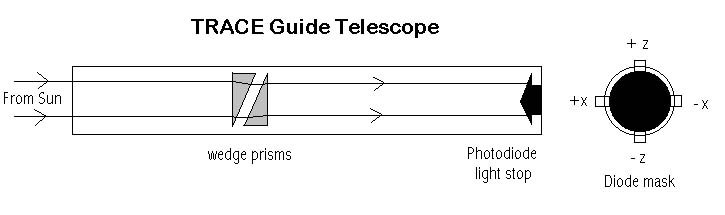
TRACE utilizes a guide telescope to point at various locations on the solar disk. Four photodiodes within the guide telescope monitor the position of the edge of the Sun, or solar limb. The guide telescope is able to tell the ACS when the spacecraft moves relative to this edge. The ACS receives these pointing error signals and commands the wheels to spin a certain direction so that the spacecraft points to a new location and thus rebalances the photodiodes. To change to a new position on the solar disk, the flight computer commands a pair of wedge prisms contained within the guide telescope. The wedge prisms shift the appearance of the limb on the photodiodes. The photodiodes then report an error signal to the ACS and again the spacecraft moves. This process is repeated until the spacecraft is pointed to the desired location on the Sun.