
TRACE Battery
TRACE uses a nickel cadmium battery which converts chemical energy to electrical energy upon discharge and converts electrical energy back to chemical energy upon recharge. Nickel cadmium is the most commonly used battery for Low Earth Orbit (LEO) missions. A spacecraft battery consists of series-connected cells, the number of which depends upon bus voltage requirements and output voltage of the individual cells. The TRACE battery was designed to output ~28 Volts from 22 cells at ~1.3 volts/cell. The actual output voltage will vary with temperature and charge provided to it. The power system electronics can regulate how much charge the battery receives so that the battery can supply anywhere from 22 to 34 volts. Currently, the TRACE battery outputs 31.5 Volts. As the individual battery cells degrade, it may be necessary to increase the charge to them or decrease it to avoid stress on the battery.
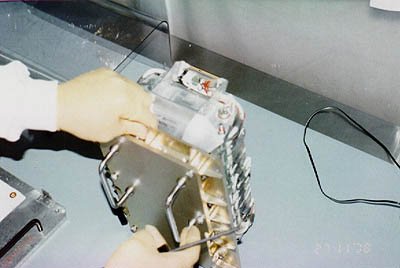
The Qual Battery
The amount of energy stored within the battery is specified in ampere-hour (Amp-hr) capacity. TRACE uses a 9 Amp-hr battery meaning it can supply 1 amp of current at 28 Volts for 9 hours. TRACE could survive about 4-6 hours if it had to rely solely on the battery for power.
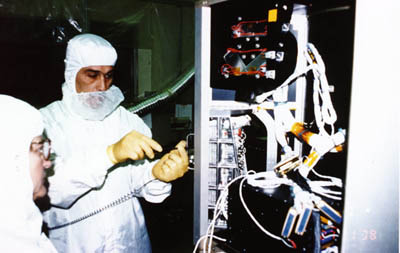
Steve Patton torques down the qual battery.