
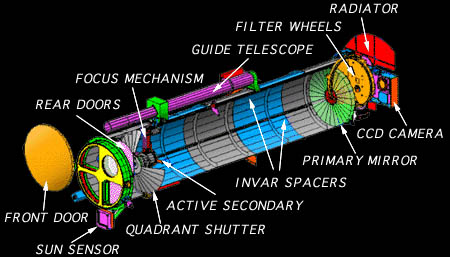
Diagram of Instrument
The TRACE satellite is designed to obtain images and movies of the solar transition
region and corona with an angular resolution of one arcsecond (this corresponds to a spatial resolution at the Earth-Sun distance of about 725 kilometers); a sequence of images in different wavelengths or in the same wavelength can be
taken only a few seconds apart. TRACE lets us explore the
fine details and the motions of the magnetic structures in the temperature
range from 10,000 Kelvin up to several million Kelvin. The TRACE mission
offers uninterrupted observing for months at a time, due to a sun-synchronous orbit. TRACE is operated
in conjuction with the Solar and Heliospheric Observatory (SOHO) at Goddard Space Flight Center. The coordination of
TRACE with SOHO and with other instruments, both in space and on the ground,
provides a unique opportunity to track the response of the solar atmosphere from the photosphere outward to the dynamic, evolving magnetic field which emerges, from the solar surface by combining a suite of powerful observing tools: for example, using TRACE as a high-cadence microscope to 300 m in on the action, with larger-scale context from SOHO imagers, diagnostics of plasma conditions such as temperature and density from SOHO spectrometers, and minute by minute snapshots of the photospheric fields by SOHO's magnetometer.
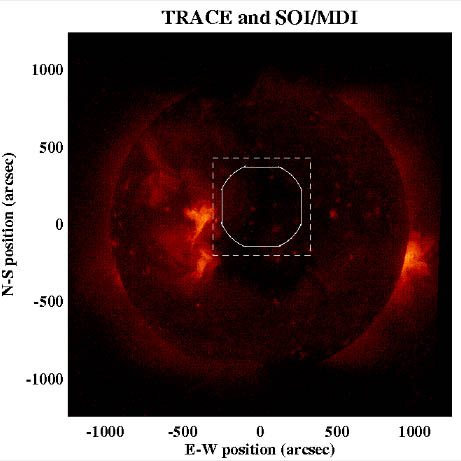
The TRACE telescope has an aperture of 30 cm, and observes an 8.5 x 8.5 arcminute field of view (about 10% of the solar disk) in a single pointing with a resolution of one arcsecond. Full-Sun mosaics can be made by stepping the field of view across the disk. Coatings on four quadrants on the primary and secondary normal-incidence mirrors allow observations in narrow spectral bands tuned to the Fe IX (9*ionzied Iron, 171 Angstroms), Fe XII (12*ionized Iron, 195 Angstroms), and Fe XV (15 *ionzided Iron, 284 Angstroms) lines in the EUV band, while filters allow observations in C IV, Lyman alpha, and in the Ultraviolet (UV) continuum using the UV mirror quadrant. The EUV bands are sensitive to coronal temperatures of about 1 to 2 million Kelvin, while the UV filters respond primarily to the temperature regimes of the photosphere, chromosphere, and transition region. The Sun-synchronous orbit allows long intervals of uninterrupted viewing. Observations at different wavelengths can be made seconds apart. Pointing is internally stabilized to 0.1 arc second against spacecraft jitter.
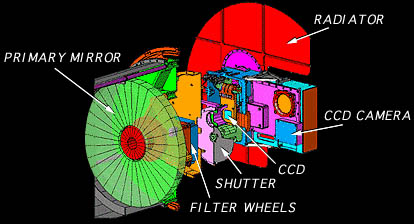
Diagram of focal plane
The 30 cm aperture TRACE telescope uses four normal-incidence coatings for the Extreme Ultraviolet (EUV) and UV on quadrants of the primary and secondary mirrors. The segmented coatings on solid mirrors form identically sized and perfectly coaligned images. A 1024 x 1024 Charge-Coupled Device (CCD) detector collects images over an 8.5 x 8.5 arc minute field-of-view (FOV). A powerful data handling computer enables very flexible use of the CCD array including adaptive target selection, data compression, and fast operation for a limited FOV.
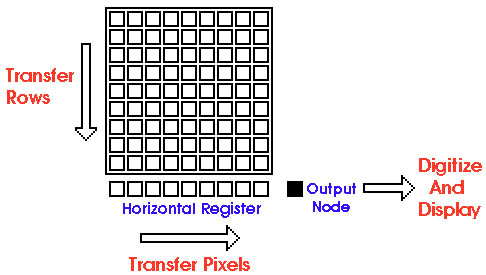
Charge-Coupled Device
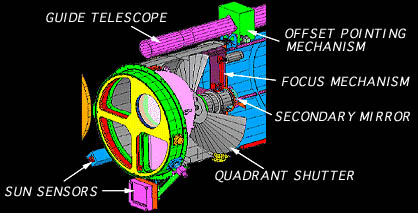
Diagram of the front end of instrument
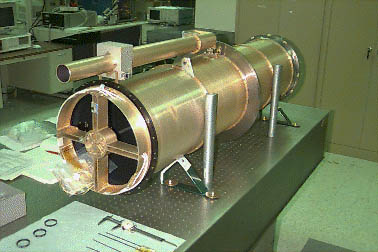
TRACE telescope housing and guide telescope
Extensive heritage enabled the TRACE team to create an instrument
more capable than might be expected on a Small Explorer (SMEX) budget. The Harvard Normal Incidence XUV Telsecope (NIXT) payload took the highest resolution EUV coronal images ever, and
the NIXT team provided the mirrors for TRACE. The Yohkoh Soft X-ray Telescope (SXT) instrument had produced more than
two million soft X-ray images of breathtaking quality. To manage,
process, and analyze the SXT data, a very complete
set of well documented image cataloging, archiving, and analysis
software was produced, which could be used for the TRACE investigation. The Michelson Doppler Imager (MDI) program produced a complete
flight instrument for SOHO including a CCD camera, image stabilization
system, control and data handling
computers, software, and highly reliable mechanisms. Many
of the MDI designs and some of the spare flight hardware were used
on TRACE. The personnel (scientific, engineering, and management) and
facilities assembled for SXT largely carried over to TRACE. These factors
permitted a sophisticated instrument within the cost and time
constraints of the Small Explorer program. Operational experience
and the software base developed from the La Palma Solar Optical Universal Polarimeter (SOUP) and the SXT and MDI missions enabled TRACE to quickly and efficiently generate scientifically important and visually exciting results.