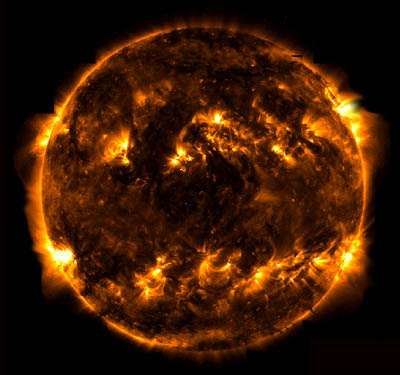
To view the various layers of the sun, click here.There are three main sections inside the Sun. The first is the core which is the innermost part of the Sun. Energy in this part is generated by nuclear reactions. The core has a temperature of 15.6 million Kelvin and a pressure of 250 billion atmospheres. The density of the gases inside the core is 150 times that of water. Thermonuclear fusion is responsible for the Sun's energy output of 386 billion billion megawatts. Almost every second 700,000,000 tons of hydrogen is converted to 695,000,000 tons of helium and 5,000,000 tons of energy in the form of gamma rays. As the energy travels outward, it is repeatedly absorbed and re-emitted as the temperature drops. Next comes the radiative zone, where energy travels outward by radiation through about 70% of the Sun. The radiative zone extends inward, partially overlapping the core. As energy from the core radiates outward through the radiative zone, the temperature drops to about 2 million Kelvin. The outermost part is the convection zone, where gas flows drag the Sun's energy. The convection zone extends nearly to the Sun's surface and at the top has a temperature of 6,000 Kelvin. By the time the energy reaches the surface, it is mainly in the form of visible light.
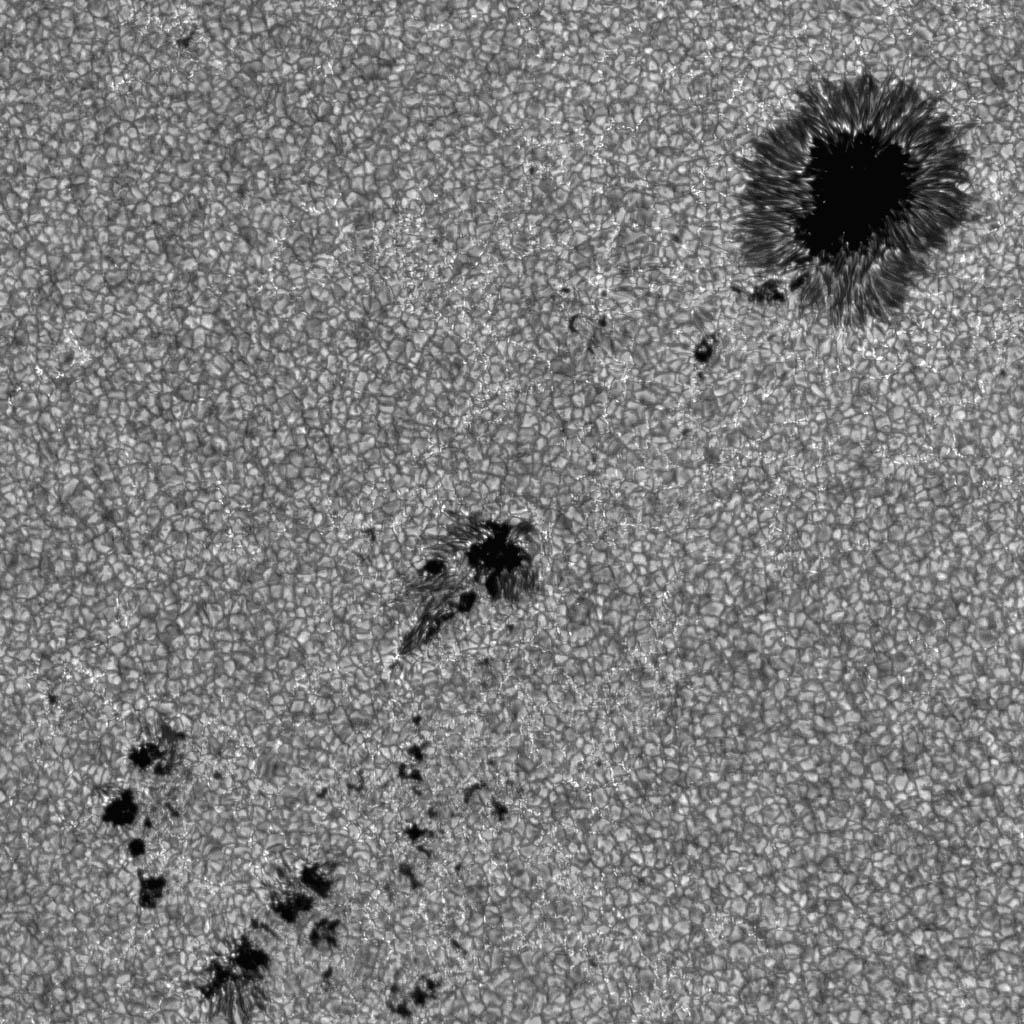
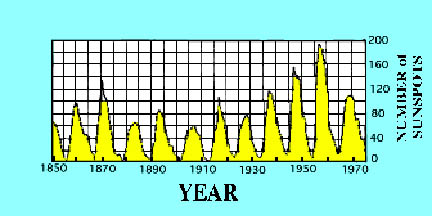
The surface of the Sun is known as the photosphere. It has a temperature of about 5800 Kelvin. A sunspot (pictured below) is a cool region with a temperature of only 3800 Kelvin. A sunspot can be as large as 50,000 kilometers across and consists of concentrations of strong magnetic field. The amount of sunspot activity is not constant, but appears to go through about an eleven year cycle, as shown in the plot of the number of spots over time, below the sunspot picture. The sunspot picture below also shows pores, which are spots without penumbrae.
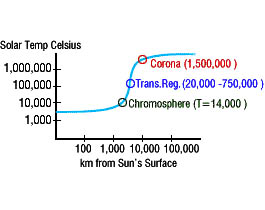
The chromosphere is a region that tends to lie above the photosphere and has a temperature of about 10,000 Kelvin. This is where all sorts of violent solar eruptions can be found. This is also the region where a mysterious temperature phenomena occurs. A predictable decrease in temperature occurs for about 500 kilometers above the solar surface and then the temperature begins to increase for reasons not fully understood. The corona tends to be located above the chromosphere and extends millions of kilometers out into space. The corona has a temperature of over 1,000,000 Kelvin and is visible in white light during an eclipse or by use of a special instrument called a coronagraph (which blocks the brighter light from the solar disk). The diagram below shows the classical locations of the corona, the transition region and the chromosphere and their respective temperatures. Notice how the temperature goes up as one travels outward away from the surface (photosphere). This is one of the mysteries that scientists hope that TRACE will help solve.
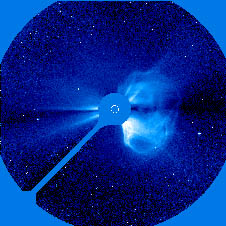
As discussed in the Solar Terrestrial Effects section, the Sun radiates heat in the form of visible light and also produces the solar wind. The solar wind is a stream of charged particles that moves throughout the solar system at about 450 km/s. This wind affects the tails of comets and the trajectories of spacecrafts. Another group of solar phenomena that affect the Earth are known as Coronal Mass Ejections (CME) and solar flares. Below is a picture of a Coronal Mass Ejection (CME) captured by the Large Angle and Spectrometric Coronagraph (LASCO), an instrument on board SOHO.The Earth experiences a variety of effects from the solar wind as well as the energetic particles ejected by solar flares and coronal mass ejections. These topics will be more thoroughly discussed in the Terrestrial Effects section.
Below is a Herzsprung-Russell (H-R) diagram representing the life cycle of the Sun. An H-R diagram shows the temperature and luminosity changes during the life of a star and in this case the life of our Sun.
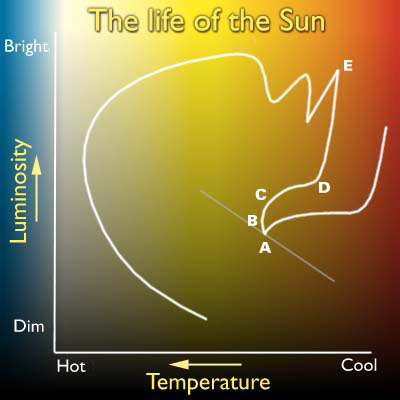
Reference for H-R diagram and description: http://www.astro.uva.nl/demo/sun/leven.htm