
The solar arrays or solar panels of TRACE are the primary
source of power for the spacecraft and its various
subsystems. They are the four, large, sheet like objects that protrude from the craft. The solar
panels are composed of special materials known as photovoltaics which are multi-layer
composites that convert light into usable electricity when the light falls on the surface of the panels. The typical
compounds used in space based solar panels are crystalline silicon and gallium arsenide.
Crystalline silicon ingots are sliced into wafer-thin circles, and metallic conductors
are deposited onto each surface: a thin grid on the Sun-facing side and a flat sheet on the
other. Spacecraft solar panels are constructed of these cells trimmed into appropriate shapes
and cemented onto a substrate. The cement and the substrate must be thermally conductive,
because in flight the cells absorb a lot of infra-red energy and tend to reach high temperatures.
They are more efficient when kept to lower temperatures. The resulting assemblies are called
solar panels or solar arrays.
Solar power is practical for spacecraft operating no farther from the Sun than about the orbit of Mars.
Most other Earth-orbiters use solar power. Due to the solar observing nature of the TRACE mission, the
solar panels are fixed, pointing directly at the Sun. Prolonged exposure to sunlight causes photovoltaics'
performance to degrade by about a percent or two per year, more rapidly during solar
maximum periods due to the increased solar radiation.
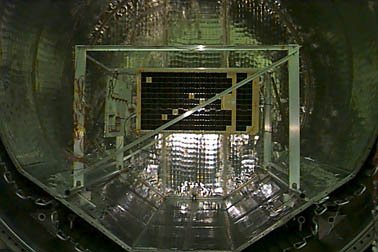
Solar Array Flash Testing
Flash testing is a procedure during which the individual array cells are illuminated with white light and the resulting output voltage and current are measured. If one cell is damaged, it must be replaced prior to flight. This test is performed prior to spacecraft integration and repeated after certain environmental tests.