
The onboard computer (SCS) is responsible for overall management of a spacecraft's activity.It maintains
timing, interprets commands from Earth, collects, processes, and formats the telemetry data which
is to be returned to Earth, and manages high-level fault protection and safing routines.
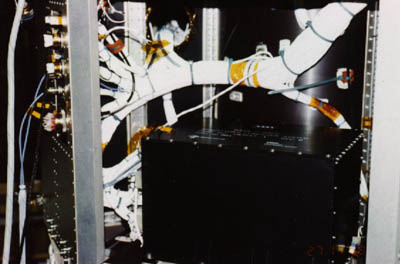
The TRACE computer system operates at 100 Hz or 100 instructions per second. The spacecraft clock synchronizes activities once a second. All computer subsystems, the instrument, and the Attitude Control System (ACS) receive this timing signal and begin executing their tasks after receipt. The ACS sends the SCS vital attitude sensor data for processing and in turn the SCS sends actuator instructions to the ACS. The instrument sends solar image data to the SCS bulk memory over a dedicated high speed data bus as well as engineering data on its health and safety.
Fault protection is a very important task that the SCS performs. A spacecraft system must have the intelligence and autonomy to monitor and control itself to a degree throughout its useful life while in orbit. Although TRACE is in contact with ground stations 6 times per day, only one or two of those contacts are manned by human ground controllers. That's only 20 minutes per day! Fault protection algorithms, which reside in both the SCS and ACS boxes, insure the ability to both prevent a mishap and to re-establish contact with Earth if a mishap occurs. Some important autonomous actions that TRACE employs are listed below:
* Solar array deployment
* ACS safehold mode to orient the spacecraft towards the Sun
* Load shedding due to low battery state of charge, low battery voltage or high currents or temperatures
* SCS reboot for hung tasks or memory checksum errors
* SCS power cycling upon no ground command receipt for 28 hours
The hardware components of the SCS consist of one 80386 based processor card, 300 megabytes of bulk memory, a power converter, an I/O card, an uplink/downlink card and a backplane bus for communication within the computer. An external data bus links communications between the SCS and the instrument, ACE, and SPE subsystems. The SCS is responsible for the execution of both ACS and C&DH software.
You may think that the computer technology is rather antiquated since after all it is based on a 386 processor, long since removed from use in your home PC. The reason for this is the severe radiation environment found in space. High energy protons and electrons trapped in the Earth's magnetic field often penetrate spacecraft computer systems causing single and sometimes multiple bit flips in computer memory. Bit flips, from 0 to 1 or vice-versa, alter the content of memory, which depending on location may distort the stored science data or worse yet, the code which operates the spacecraft. For this reason, spacecraft designers must use radiation hardened, space qualified parts. Today's cutting edge computer technology on your desktop may not be ready for space use for another 5-7 years or so.